Did you know that the Centers for Disease Control and Prevention (CDC) says eating too much saturated fat can raise your cholesterol? This is crucial for keeping your heart healthy. Knowing how saturated fats and cholesterol affect each other helps lower heart disease risks.
The American Heart Association (AHA) suggests eating less saturated fat, just 5-6% of daily calories or 13 grams on a 2,000 calorie diet. Eating heart-friendly foods like fruits, vegetables, and whole grains helps. For tips on keeping your cholesterol in check through diet, see: foods to eat and avoid.
Making the right food choices can help you reach a healthy cholesterol level, between 125 and 200 mg/dL. It’s important to check your cholesterol often and get advice from doctors. Knowing about saturated fats helps you lower your risk and keep your heart healthy.
Key Takeaways
- Saturated fats can raise LDL (bad) cholesterol levels, increasing the risk of heart disease.
- The AHA advises that no more than 5-6% of daily calories should come from saturated fats.
- Foods high in saturated fats include beef, cheese, and palm oil, which should be limited.
- Adopting a diet rich in whole grains, vegetables, and plant-based proteins supports heart health.
- Regular monitoring of cholesterol levels is essential for maintaining cardiovascular well-being.
- Dietary adjustments combined with physical activity can significantly reduce cholesterol levels.
Understanding Dietary Fats
Dietary fats are key to good health. They give us energy and support our body’s functions. Knowing the different fats can help us choose wisely for better health.
Types of Dietary Fats
There are three main types of fats: saturated, unsaturated, and trans fats. Each affects our health differently.
- Saturated Fats: These are solid at room temperature. You can find them in animal products and some oils.
- Unsaturated Fats: These are usually liquid at room temperature. They’re in items like olive oil and nuts, and are healthier.
- Trans Fats: Made by adding hydrogen to oil, they’re in some processed foods. Trans fats are bad for your cholesterol levels.
Significance of Dietary Fats in the Body
Fats are more than just energy. They help with hormone regulation and support our cells. They also help us absorb vitamins.
Our body needs essential fatty acids from our diet to stay healthy. These can’t be made by our body.
| Type of Fat | Sources | Health Effects |
|---|---|---|
| Saturated Fats | Meats, dairy, coconut oil | May raise LDL cholesterol levels |
| Unsaturated Fats | Olive oil, nuts, fatty fish | Can lower bad cholesterol levels |
| Trans Fats | Partially hydrogenated oils | Increase risk of heart disease |
Choosing healthy fats is important for our health. By eating the right fats and balancing our diet, we can live a heart-healthy life.
What are Saturated Fats?
Saturated fats are fat molecules packed with hydrogen, which makes them solid at room temperature. They are found in many foods and add to our total fat consumption. It’s important to know where they come from and understand the health risks they may pose to keep our diets healthy.
Sources of Saturated Fats
Saturated fats are found in:
- Red meats
- Poultry (especially with skin)
- Dairy products like butter and cheese
- Coconut oil and palm oil
Men should eat no more than 30g of saturated fat a day, and women should limit themselves to 20g, according to UK guidelines. It’s useful to check food labels to spot sources of saturated fat. This helps in choosing healthier food options.
Health Implications of Saturated Fats
Eating saturated fats can lead to higher levels of LDL cholesterol, known as “bad” cholesterol. High levels increase the risk of heart disease and stroke. Experts suggest keeping saturated fat below 10% of our daily calories. The American Heart Association suggests even lower amounts.
Alternatively, unsaturated fats, like those in olive oil and avocados, help maintain good HDL cholesterol. We should eat more of these healthy fats and cut down on saturated fats. This can better our heart health and reduce the risk of serious health problems.
Impact of Saturated Fats on Cholesterol Levels
Saturated fats are key in raising LDL cholesterol levels. This affects heart health. Knowing their impact helps us choose what to eat wisely.
How Saturated Fats Affect LDL Cholesterol
Eating saturated fats can hike your LDL cholesterol, more than most other nutrients. Studies tell us diets rich in these fats boost LDL concentrations. Those are the bad cholesterol particles.
Not all saturated fats do this equally. For instance, lauric acid hikes LDL more than others. Myristic and palmitic acids follow. But stearic acid? It doesn’t affect LDL or HDL cholesterol at all.
The Role of HDL Cholesterol
HDL cholesterol helps shield us from heart disease. It clears extra cholesterol from our blood. Yet, eating too much saturated fat can drop HDL levels. This ups the risk of heart problems.
Different things can change how your body reacts to saturated fats. Like, the cholesterol you eat, your LDL starting point, and your genes. High saturated fat consumption can lower HDL, showing we need a balanced diet.
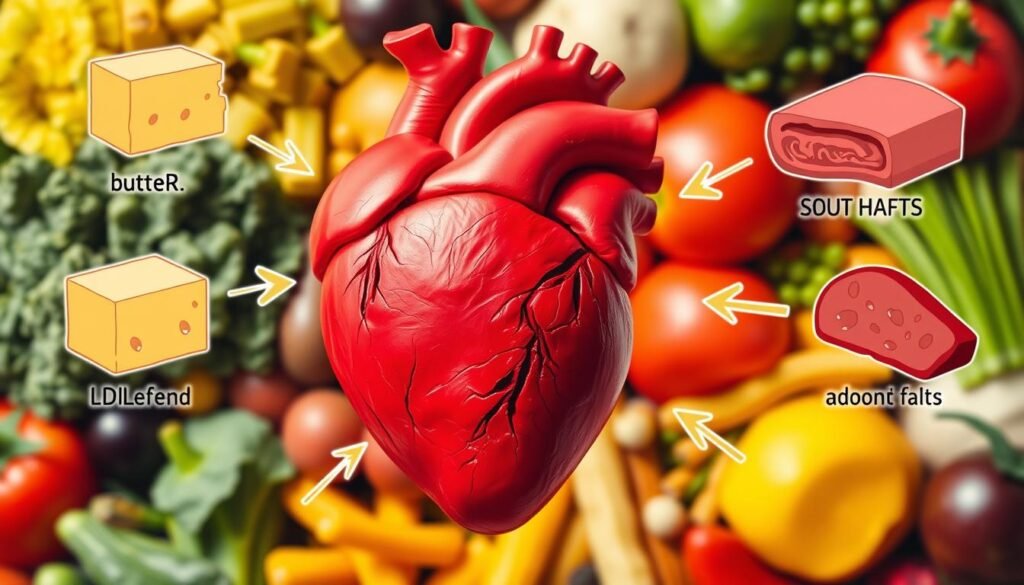
| Food Item | Saturated Fat Content (g) |
|---|---|
| 8 oz New York steak | 14 |
| Cheeseburger | 10 |
| Vanilla shake | 10 |
| 1 tablespoon of butter | 7 |
Experts say to keep saturated fats under 10% of our daily calories. That’s about 22 grams for a 2,000-calorie diet. Reading food labels helps spot saturated fat content. A 5% value is low, but 20% is high.
To cut saturated fats, try eating less red meat. Opt for lean proteins instead. Choosing oils over butter can also help lower bad cholesterol. This supports a healthier heart.
Saturated Fats and Cardiovascular Health
The link between saturated fats and heart health is widely studied. Studies show that consuming lots of certain saturated fats increases heart disease risk. Specifically, eating more lauric, myristic, palmitic, and stearic acid raises the risk by 18%. This highlights the importance of reviewing our diets.
Relationship with Heart Disease
Cutting down on saturated fats is key for heart health. Experts suggest keeping them below 10% of our total calories. By swapping just 1% of saturated fats with healthier options, we can cut heart disease risk by 6%-8%. Palmitic acid, especially, impacts heart health. It’s in palm oil, meat, and dairy.
Current Research Findings
Recent studies like the Nurses’ Health Study shed light on food’s impact on heart disease. With over 115,000 people involved, this research was funded by the National Institutes of Health. It promotes eating more fruits, vegetables, and whole grains. It also suggests that full-fat dairy can be part of a healthy diet, posing less risk than processed foods. It’s crucial to use current research for understanding diet’s effect on heart health.
Identifying Trans Fats and Their Effects
Trans fats are an unsaturated fat changed through a hydrogenation process. This turns liquid oils solid. They’re common in many processed foods, especially those using partially hydrogenated oils. It’s important to know about trans fats to keep your heart healthy. They can boost the risk of heart diseases.
What are Trans Fats?
Trans fats appear mostly in processed and fried foods. Examples include doughnuts, cookies, and crackers. These fats increase LDL (bad) cholesterol and decrease HDL (good) cholesterol. This bad mix heightens the danger of heart disease and strokes. To eat safely, read ingredient labels carefully. Learn how to spot trans fats in your meals by visiting identifying trans fats.
Health Risks Associated with Trans Fats
The dangers of eating trans fats are scary. These fats play a big part in causing heart problems. They make LDL cholesterol go up, harming your blood vessels. This increases your chance of getting heart disease. In recent years, there’s been a push to eat less trans fats. This includes banning them in some places.
Laws now make companies say how much trans fat is in their products. But, some still say “no trans fats” if they have less than 0.5 grams per serving. It’s misleading.

Educating people on the health risks has improved public health rules. Many groups, like the American Heart Association, advise eating less trans fats. They suggest choosing healthier fats instead. Good choices are monounsaturated and polyunsaturated fats. They’re found in nuts, fish, and vegetable oils.
Unsaturated Fats: The Healthier Choices
Unsaturated fats are key for staying healthy. They are liquid at room temperature. This group includes monounsaturated fats and polyunsaturated fats. Both kinds are crucial for a good diet.
Types of Unsaturated Fats
You’ll find monounsaturated fats in olive oil, avocados, and nuts. They boost heart health by improving cholesterol. Polyunsaturated fats have omega-3 and omega-6. They’re in fatty fish and certain oils. These fats fight inflammation and can lower triglyceride levels.
Benefits of Unsaturated Fats
Adding unsaturated fats to your diet has many pluses. They are:
- Lowering bad LDL cholesterol levels
- Reducing body inflammation
- Boosting heart and overall health
- Bettering blood lipid levels
- Helping regulate blood pressure
The American Heart Association suggests getting 8-10 percent of your daily calories from polyunsaturated fats. Foods high in unsaturated fats are tasty and good for your health for the long run. They are a must for eating well.
| Type of Fat | Sources | Health Benefits |
|---|---|---|
| Monounsaturated Fats | Olive oil, avocados, nuts | Improve cholesterol levels, heart health |
| Polyunsaturated Fats | Fatty fish, sunflower oil, walnuts | Reduce inflammation, lower triglycerides |
Understanding Triglycerides
Triglycerides are a key type of fat in the blood which help in storing energy. They come from extra calories we eat. High levels of triglycerides can lead to serious health problems. It is crucial to know how they work and their difference from cholesterol for heart health.
What Are Triglycerides?
Triglycerides store energy and are found in the blood. They are mainly from fats and carbohydrates in food. When we eat more calories than we burn, these extra calories turn into triglycerides and are stored in fat tissue. Normal levels are below 150 milligrams per deciliter (mg/dL). High levels can raise the risk of heart disease.
Triglycerides vs. Cholesterol
Triglycerides and cholesterol are different. Cholesterol is a waxy substance made by the liver or from food. It helps in making hormones and building cells. But, triglycerides simply store energy. Both are important for heart health. High triglycerides often go hand-in-hand with high bad cholesterol, raising the risk of heart problems like atherosclerosis.
Controlling triglycerides means exercising and eating right. Sometimes, medication is needed. Keeping an eye on both triglycerides and cholesterol is key. For more about managing cholesterol, visit this resource.
Recommendations for Healthy Eating Habits
It’s key to have healthy eating habits for great cholesterol levels and heart health. One important part is to cut down on unhealthy fats. These include saturated and trans fats that harm cardiovascular health. People should stay away from butter, stick margarine, shortening, and certain oils. Palm and coconut oils are examples. Also, try not to have too much commercially prepared mayo, gravies, and salad dressings. It’s better if they’re made with low-fat items at home.
Limiting Saturated and Trans Fats
Improving your diet includes choosing nonfat or low-fat dairy. Pick milk, yogurt, and cottage cheese to cut saturated fat. Also, Americans usually eat more sodium than they should, going over 2,300 milligrams daily. Keeping sodium low and choosing whole-grain breads, cereals, and pastas is smart. This helps lower heart disease risk. Limit egg yolks to about three to four a week since they have cholesterol.
Incorporating Healthier Fats
Adding healthier fats to your diet is crucial for a heart-healthy lifestyle. Use olive oil, nuts, and fatty fish with omega-3 fatty acids. These fats can lower cholesterol. The Mediterranean Diet is great for this, focusing on plant-based foods and healthy fats. Cooking meals at home and using vegetable oil sprays helps. This way, you control what you eat and stay healthy. Regularly watch your fat intake, and eat plenty of fruits, vegetables, and whole grains. This will improve your heart health and manage cholesterol better.