Did you know that childhood immunization rates have dropped to their lowest in 30 years? Many kids have not received any vaccines at all, known as zero-dose children. This big drop is a real danger to public health.
The fight against COVID-19 took funds away from regular vaccinations. Because of this, countries are working hard to get back to how things were before the pandemic. It’s very important to keep up with health research. It helps us find better ways to improve health for everyone.
Healthcare changes fast, making it crucial to stay updated on health research. By learning about new discoveries, we can make smart choices for our health based on science. This article is a door to knowledge about health advancements. It will help you and your loved ones face future health issues with more confidence.
Key Takeaways
- Staying informed about health research is crucial for enhancing personal and public health.
- The decline in childhood immunization rates raises significant concerns for public health.
- Technology, including apps, is transforming how health information is accessed and utilized.
- Advocacy and education on vaccines are essential to combat misinformation.
- Subscribing to health publications and digital newsletters can keep individuals updated on the latest health trends.
- Collaborating with online forums and attending conferences can enhance understanding of research advancements.
The Importance of Staying Informed About Health Research
Knowing about health research is key for making smart choices about your health. When you know the latest in health news, you can act early. This can lead to better health.
A lot of people don’t know they could join clinical trials when they get sick. 85% of patients didn’t know they could at diagnosis time. Yet, 75% would have joined a trial if they knew they could. This shows we need to teach people more about health studies.
Most patients, 77%, who joined trials heard about them from their doctors. This shows doctors are important in sharing trial info. But only 32% said their doctors explained the trials well. This means we need better communication.
The medical world is always changing, so learning all the time is a must. Doctors who keep up with new info tend to do a better job. They’re happier in their work, too. Places like the National Association for Home Care & Hospice and the Centers for Medicare & Medicaid Services help them stay informed. Using these resources makes for better care and fills the gap in knowledge about health studies.
Latest Breakthroughs in Cancer Treatment
Recent health research advancements are changing cancer care. These studies show big breakthroughs that could make treatment better for patients. Two major discoveries are making people rethink how to fight cancer.
Foundational Technology to Make Cancer Cells Revert to Normal Cells
A new technology might change cancer cells back to normal cells instead of killing them. This kinder approach could lead to better treatments. It highlights the importance of new medical breakthroughs.
Microscopic Discovery in Cancer Cells Could Have a Big Impact
Recent work has shown how cancer cells’ physical traits are crucial. Knowing this could open up new ways to treat cancer. This moves science forward, offering hope for new treatments.
| Breakthrough | Description | Status |
|---|---|---|
| Reverting Cancer Cells | A technology to transform cancer cells to a normal state. | In Development |
| Mechanical Properties of Tumors | Discovery that highlights the physical environment of cancer cells. | Research Published |
Innovative Approaches to Genetic Research
Recently, scientists have made exciting progress in genetic research, especially for Alzheimer’s disease. They’ve found new methods that could change how we treat this illness. These advanced strategies are making a big difference in fighting complex diseases.
Gene Editing Tool Reduces Alzheimer’s Plaque Precursor in Mice
A team of researchers created a new gene editing tool. It targets amyloid-beta plaque, a key Alzheimer’s trigger, in mice. Using CRISPR technology, the method decreased harmful proteins, offering hope for future treatment strategies. This marks a significant leap in our fight against neurodegenerative diseases.
New Research Identifies Key Cellular Mechanism Driving Alzheimer’s Disease
A fresh study uncovered a crucial cellular mechanism behind Alzheimer’s. It sheds light on the disease’s underlying biology. This discovery opens new paths for treatments, cementing the role of genetic research in disease comprehension. It promises to guide more tailored approaches to battling Alzheimer’s.
Advancements in Vaccine Acceptance and Development
Recent studies show people are now more open to vaccines, especially the RSV vaccine. People understand its benefits better, helping protect the very young and elderly. Knowing the latest medical findings is key to this change, as new data boosts confidence in vaccines.
Public Shows Greater Acceptance of RSV Vaccine
Last year’s research shows fewer people doubting vaccines, creating a supportive atmosphere for health efforts. Reviews from different groups pinpoint what makes people accept or hesitate over vaccines. Main concerns are about safety, how well it works, and cultural beliefs.
Getting to know the vaccine process and trusting doctors help increase confidence. Talking clearly about how vaccines prevent diseases can improve health for everyone. Keeping up with medical research guides people towards well-informed health choices.
Cutting-Edge Research in Nanotechnology
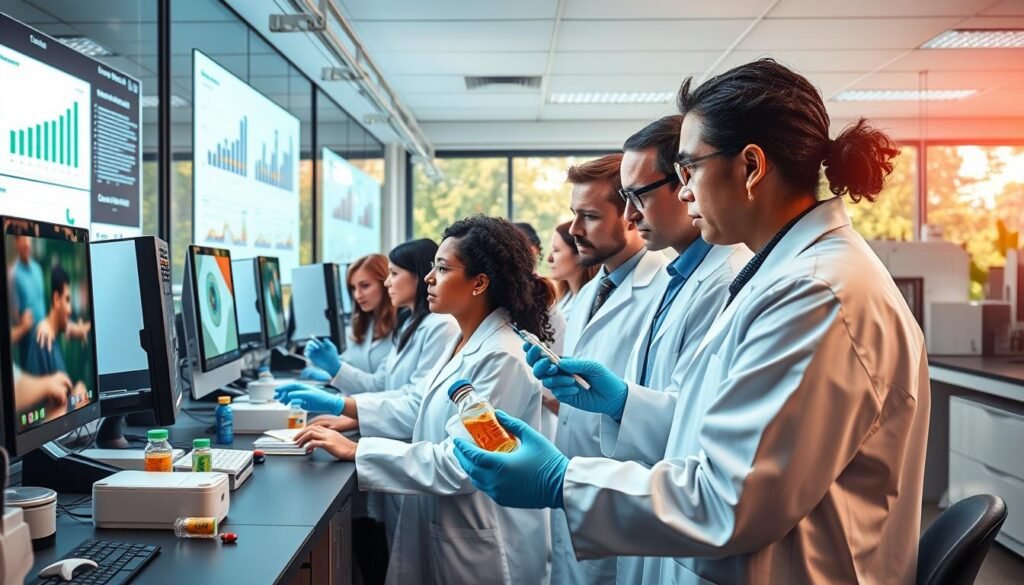
Recent work in nanotechnology has changed healthcare a lot, mainly because of high-quality nanodiamonds. These tiny materials offer big chances for looking inside the body and for quantum sensing. The new steps in healthcare research news show us how tiny tech reshapes the way we treat and diagnose diseases.
High-Quality Nanodiamonds for Bioimaging and Quantum Sensing Applications
Materials that are super small, between 1 and 100 nanometers, are making a big splash. Nanodiamonds stand out by helping deliver drugs accurately and spotting cancer early. They make image tests like MRI, CT scans, and PET scans better and more sensitive. With these neat features, nanodiamonds help doctors see what’s happening in our bodies in real time. This greatly helps patients get better.
Latest new medical discoveries show nanomaterials are also good for making biosensors. These can spot tiny amounts of body molecules. Catching diseases early is key in today’s healthcare. Plus, tech that uses nanotechnology, like tiny fluid systems and nanopore sequencing, helps diagnose complex diseases quickly.
Nanodiamonds show how important nanotech is for making medical tests quicker and more right on point. Researchers are digging deeper into this area. They aim to save more lives with better disease detection and treatment ways.
New Techniques to Improve Health Outcomes
Innovations are transforming how we improve health. A new research update talks about a lung scan. It offers deeper insights into lung functions. This is especially good news for those with breathing problems. Knowing about these advances helps us understand new treatments better.
New Scan Method Unveils Lung Function Secrets
A new scan for the lungs uses advanced imaging. It shows how air moves in our lungs. This can spot issues early and lead to quick help. It gives hope for healthier lives by using the latest research in care.
Propranolol Reduces Tremors in Parkinson’s Disease
Recent findings show Propranolol helps with Parkinson’s disease tremors, especially under stress. This supports tailored treatment approaches. Staying updated on such research is key to improving care methods.

Staying Informed About Health Research: Key Resources
Getting your hands on trustworthy resources is key for anyone into health research. To stay updated, it’s more than just checking out the new studies. It means diving into different platforms that share deep insights. Important groups like the National Institutes of Health (NIH) and the Centers for Disease Control and Prevention (CDC) have detailed databases. These are vital for getting the scoop on health data and trends.
Sites like Twitter and Facebook help with instant updates on health research. When you follow reliable sources, like health groups or universities, you won’t miss out on the latest discoveries or studies. If you like stories, try reading science blogs or popular health books. They give a special view that makes understanding health issues easier and more fun.
Listening and watching materials are big in teaching health too. Podcasts, such as Radiolab and Hidden Brain, talk over research breakthroughs. They use storytelling to make things clearer. Watching documentaries on platforms like Netflix and Amazon Prime digs deeper into health problems. This is awesome for those wanting a more catchy way to learn.
The table below shows a mix of ways to stay informed about health research:
| Resource Type | Examples | Benefits |
|---|---|---|
| Websites | NIH, CDC | Reliable databases with latest health information |
| Social Media | Twitter, Facebook | Real-time updates from credible sources |
| Blogs | PLoS Blogs, Science Blogs | In-depth analysis and expert opinions |
| Podcasts | Radiolab, Hidden Brain | Narrative discussions that enhance understanding |
| Documentaries | Netflix, Amazon Prime | Visual storytelling on health topics |
| Educational Videos | YouTube, TED Talks | Concise and engaging format for complex concepts |
Want more tips on how to keep up with important health research? Visit this resource. Using these varied channels can give you a full view of health issues. It also helps you make smart choices.
Current Trends in Healthcare Research News
The healthcare world is changing fast, driven by major trends in society and tech. Studies now show a big move toward new ways of caring for people. This includes ‘hospital-at-home’ programs where patients get top-notch care right at their homes.
Adoption of ‘Hospital-at-Home’ Programs
Hospitals are changing to meet patient needs better. ‘Hospital-at-home’ programs are a key part of this change. They bring several benefits, including:
- Reduced hospital stays – Less time in the hospital means fewer risks related to hospital stays.
- Increased comfort – Care happens at home, which can help people feel better faster.
- Cost-effectiveness – These programs can save money because they cut hospital costs.
More and more, healthcare news talks about these ‘hospital-at-home’ programs. They fit well with trends like preventive care. This approach helps take care of an aging society better, with help from tech like virtual health assistants and IoT. AI is key in improving how well these programs work and making them more efficient.
Understanding the Economic Impact of Health Issues
Health issues in the United States show big economic differences due to social and economic factors. These differences deeply affect vulnerable groups. Looking into the economic impact of dental problems shows the struggles of these groups for fair healthcare.
Economic Burden of Tooth Decay Is Highest in Deprived Groups
Recent studies shed light on how tooth decay ties to financial challenges and health unfairness. People with less money feel the biggest impact of dental cavities, worsening inequality. If we tackle these health gaps, the US economy could grow by $2.8 trillion by 2040. This would be a huge 9.5% boost.
Also, if health fairness gets more focus, US businesses could earn $763 billion more. But, if we ignore these health gaps, medical costs may top $1 trillion by 2040. Already, $320 billion goes to handling these issues each year.
Health gaps cause more than just high medical bills. They lead to a $115 billion loss for businesses due to mental and physical health issues. Sickness can cut productivity by up to 70%. We need better health policies to solve this.
To make the workforce healthier and the economy stronger, we must mix economic and health solutions. For deeper insight, check the studies here: this link.
| Category | Economic Burden (USD) | Impact on GDP (%) |
|---|---|---|
| Racial/Ethnic Disparities | $451 billion | 2% |
| Education-related Disparities | $978 billion | 5% |
| Total Economic Burden | $1.4 trillion | 7% |
Novel Discoveries in Infectious Diseases
New finds in the battle against infectious diseases are making waves in health research. Scientists have found key insights that might change how we prevent and treat these diseases. These breakthroughs show hopeful new ways to combat various infectious conditions.
Researchers Discover Replication Hubs for Human Norovirus
A big step forward has been made in understanding the human norovirus. Scientists have found what they call replication hubs. These hubs could help us stop the virus in its tracks. By figuring out how the norovirus multiplies in our bodies, researchers are opening doors to new ways to fight it. This find is part of a larger effort to better public health and cut down infection rates.
Research Points the Way to Lifesaving Antiparasitic Drugs
Recent studies bring hope in the development of new antiparasitic drugs. They’ve learned more about how parasites build ergosterol. This insight is crucial because many current drugs aren’t working as well anymore. By understanding parasites better, scientists believe we can make treatments that will really help those in need.
| Research Focus | Significance | Impact on Public Health |
|---|---|---|
| Replication Hubs in Norovirus | Identifies mechanisms of viral replication | Improved prevention strategies |
| Ergosterol Synthesis in Parasites | New targets for drug development | Potentially lifesaving treatments |
Want to know more about fighting infectious diseases? Check out in-depth articles on current health research findings. Diving into these topics shows how vital ongoing research is for better health worldwide.
Evaluating Trustworthy Sources for Health Information
It’s important to know how to find good health info online. With so much data out there, we need to know what’s reliable. It helps to check if health websites meet certain criteria before trusting them.
Websites that end in .gov, .edu, and .org are often more trusted. For example, MedlinePlus.gov offers over 1,000 health-related topics. This site is a reliable place for health info.
Knowing who wrote the information can make it more believable. On social media, look at where the info comes from and who supports it. Good health info gives balanced facts, not just pushing one solution.
A group of health experts checking content shows it’s trustworthy. Sites should clearly show where their info comes from. This way, you can check if it’s true. It’s also key to look at when the info was written to make sure it’s current.
It’s smart to look at different sources to get the full picture. When news talks about health, looking into the research and who paid for it is important. Talking to a doctor can also help make sense of what you find.
Today, being careful about what you believe is crucial. Watch out for signs like conflicts of interest or unknown authors. Bad grammar and spelling can also be a clue that the info isn’t great. When searching for health facts, thinking critically is essential for making wise health choices.
Latest Health Studies That Impact Public Health
Recent health studies have brought new insights, especially about environmental disasters. After the Colorado Marshall Fire, research showed worrying trends. The quality of air worsened, and health issues rose among those living nearby.
These discoveries are key to understanding the problems faced after such events. They remind us of the struggles communities endure long after a disaster has passed.
Months After Colorado’s Marshall Fire: Impact on Air Quality and Health
Weeks following the fire, the air inside homes was still unsafe. Many people suffered from health issues because of this. It shows the lasting impact of environmental disasters on our well-being.
This situation highlights the need for constant vigilance. Keeping an eye on air quality and health is crucial for recovery. It’s vital for the community’s ongoing health and safety.
Conclusion
In the changing world of health research, it’s crucial to keep up-to-date. Doing so can lead to better health outcomes for everyone. The use of proven practices for conditions like asthma, heart failure, and diabetes helps people make better health decisions. The story of nursing and its leadership role shows how important research is in making patient care better.
The recent effort to speed up applying research to healthcare shows why good communication and teamwork are important. This effort helps patients take an active part in their health decisions. As a result, people become more informed and can stand up for their health needs.
Healthcare workers should focus on using systematic reviews and solid evidence in their care. This not only improves health for each person but also helps the whole community become more aware of health issues. By following these steps, both doctors and patients move towards a healthier future. It highlights the need to stay informed about health research.