Did you know over half of Americans have low “good” cholesterol levels? It’s surprising since healthy HDL levels are key for heart health. They can greatly cut down heart disease risk. HDL cholesterol acts as our body’s defense, moving excess cholesterol to the liver to get rid of it. It protects our hearts in many ways.
This article talks about why HDL cholesterol is so important, including its role in managing cholesterol and preventing heart disease. Knowing how HDL works can help people make healthy choices. For those interested in more details about how HDL protects the heart, check out a deeper look here.
Key Takeaways
- HDL cholesterol is crucial for heart health and helps with cholesterol transport.
- Low HDL levels (men >40 mg/dL, for women >50 mg/dL) can raise the risk of heart disease.
- High HDL levels (>60 mg/dL) are linked to lower cardiovascular risk.
- Exercise and a healthy diet can improve HDL cholesterol levels.
- Knowing about apolipoproteins in HDL can help us understand its protective roles.
Understanding Cholesterol and Its Types
Cholesterol is a waxy, fat-like substance that’s key for our body’s functions. It helps build cells, produce important hormones, and make vitamin D. It moves through our blood, attached to lipoproteins. The main carriers of cholesterol are High-Density Lipoprotein (HDL), Low-Density Lipoprotein (LDL), and Very Low-Density Lipoprotein (VLDL).
LDL is often called “bad” cholesterol because it can lead to plaque build-up. This can cause atherosclerosis, which narrows arteries and ups the risk of heart disease. On the flip side, HDL is known as “good” cholesterol. It helps remove cholesterol from the blood, cutting down heart risks. This shows why it’s vital to keep an eye on cholesterol types for good health.
It’s key to know about cholesterol for heart health. Everyone 20 to 65 should get checked every five years. People, especially men 45 to 65 and women 55 to 65, need checks every 1 to 2 years. After 65, going for yearly tests is wise to catch any changes early.
| Cholesterol Type | Common Name | Health Implication |
|---|---|---|
| HDL | Good Cholesterol | Helps remove cholesterol from the bloodstream. |
| LDL | Bad Cholesterol | Can lead to plaque buildup and atherosclerosis. |
| VLDL | Very Bad Cholesterol | Contributes to the buildup of plaque in arteries. |
Many factors like diet, weight, exercise, smoking, and genes can change cholesterol levels. Making lifestyle tweaks to manage weight and boost physical activity can greatly help. This improves our cholesterol profile and keeps our heart healthier.
What is HDL Cholesterol?
HDL cholesterol, or good cholesterol, is key for our health. It keeps our lipid levels balanced. HDL moves extra cholesterol from the body back to the liver. There, it gets thrown out. This process is crucial for keeping our cardiovascular system healthy. It helps prevent blockages in blood vessels, especially those caused by LDL or “bad” cholesterol.
We need our HDL cholesterol levels to be 60 milligrams per deciliter (mg/dL) or more. This lowers the chance of heart disease and stroke. By comparing HDL and LDL cholesterol, we see HDL acts as a protector. It manages our total cholesterol levels. But, having HDL levels below 40 mg/dL for men and 50 mg/dL for women increases heart disease risk. This happens because of more LDL in the blood.
Sometimes, very high HDL levels, over 80 mg/dL, might point to health problems or genetic mutations. To raise HDL levels, changing your lifestyle helps a lot. Eating a heart-healthy diet like the Mediterranean Diet, doing regular aerobic exercise, and keeping a healthy weight are key actions. These changes can boost your HDL levels significantly.
| HDL Cholesterol Level | Category | Risk Assessment |
|---|---|---|
| 60 mg/dL or higher | Optimal | Lowest risk for cardiovascular diseases |
| 40 mg/dL or higher (Men) | Normal | Lower risk for heart disease |
| 50 mg/dL or higher (Women) | Normal | Lower risk for heart disease |
| Less than 40 mg/dL (Men) | Low | Higher risk of heart disease |
| Less than 50 mg/dL (Women) | Low | Higher risk of heart disease |
| Above 80 mg/dL | High | Potential health concerns; further testing recommended |
https://www.youtube.com/watch?v=0U7YHRW5dyc
The Role of HDL in Cholesterol Management
Understanding the HDL role in cholesterol management is key for heart health. HDL stands for high-density lipoprotein. It picks up excess cholesterol from blood and takes it to the liver to be removed.
This action helps prevent artery plaque buildup. It lowers the risk of heart disease and stroke. So, HDL is really important for a healthy heart.
To manage cholesterol well, we need to keep HDL levels up and lower “bad” cholesterol, known as LDL. High LDL can cause plaque in arteries, raising health risks. Making healthy lifestyle choices and regular checks can control both HDL and LDL levels.
Beyond cholesterol control, HDL offers more health benefits. It could help fight off sepsis, showing HDL’s wider protective roles. To raise HDL, talking to doctors about lifestyle or meds is crucial. This could better HDL levels and heart health.
How HDL Functions in the Body
HDL plays a crucial role in keeping the heart healthy. It does more than move cholesterol around. It participates in key processes that affect our heart’s health.
Cholesterol Transport Mechanism
The way HDL moves cholesterol is essential for our cells’ health. It picks up extra cholesterol from our body’s tissues. Then, it carries this cholesterol to the liver. There, the liver breaks it down and gets rid of it. This helps lower the risk of hardening of the arteries.
Reverse Cholesterol Transport Explained
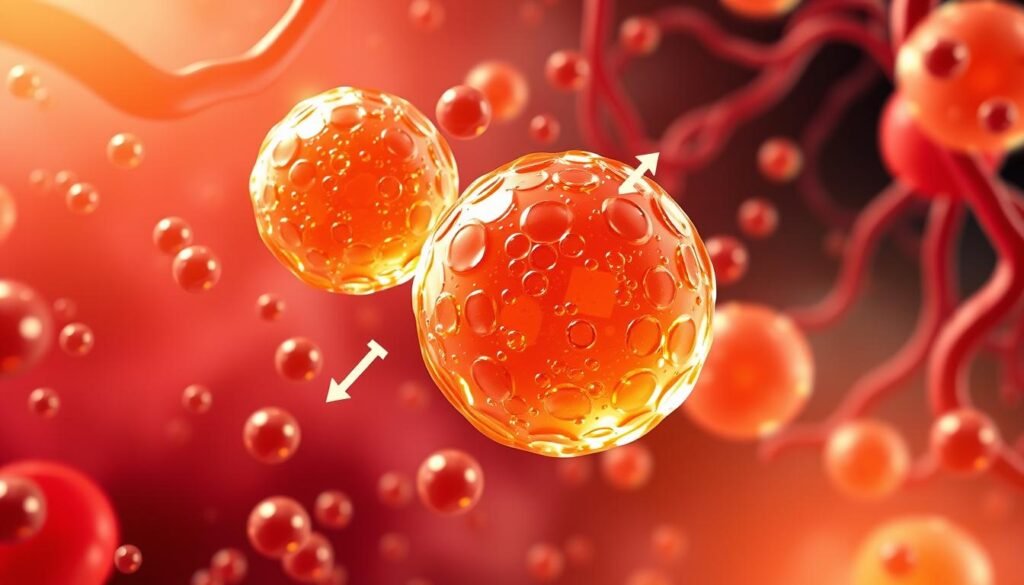
Reverse cholesterol transport is an advanced function of HDL. In this process, HDL brings cholesterol back to the liver. The liver then uses it or throws it out. HDL works with special receptors to direct cholesterol where it’s needed. This not only controls cholesterol levels but also helps remove unwanted fats. This is great for our heart health.
Impact of HDL Levels on Cardiovascular Health
HDL levels and heart health are deeply connected. It’s key to keep HDL cholesterol optimal to lower heart disease risks. People with low HDL levels have a higher chance of getting heart disease. But, high HDL levels can help protect against it.
The Link Between HDL and Heart Disease Prevention
Studies show a clear link between HDL levels and fighting heart disease. Higher HDL means less chance of heart issues. For every 10 mg/L increase in HDL, the risk of heart problems drops by 2-3%. So, it’s crucial to keep HDL levels up to avoid heart diseases.
How Low HDL Levels Affect Health
Low HDL levels are a health risk. They lead to more chances of heart diseases. Being overweight, not moving much, and eating poorly can lower HDL. This condition makes it hard for your body to handle cholesterol the right way. That’s why checking cholesterol levels is vital for heart health.
Factors Influencing HDL Levels
Knowing what affects HDL levels is key for heart health. Both what you eat and how much you move matter greatly. They help improve heart conditions by affecting these levels.
Diet and HDL Levels
Eating the right foods is crucial for HDL levels. Foods like olive oil, avocados, and fatty fish boost HDL cholesterol. But, foods high in bad fats can lower HDL, upping heart disease risks.
Eating well by choosing good fats and avoiding bad ones is important. For tips on managing cholesterol, visit this resource.
Exercise and Its Effect on HDL
Exercise has a big impact on HDL levels. Regular workouts raise HDL cholesterol and make your heart healthier. Activities like walking, running, and cycling are good for HDL.
Exercise is a key part of keeping cholesterol in check and lowering heart disease risk.

Genetic Factors and HDL Metabolism
Genes play a big role in HDL metabolism and cholesterol levels. Familial hypercholesterolemia, for example, is a genetic disorder. It leads to high cholesterol levels because of a lack of low-density lipoprotein receptors. This makes managing LDL cholesterol difficult.
Research shows mutations can affect HDL levels. Those with Apolipoprotein C-III mutations have up to 39% lower triglycerides and 22% higher HDL-C. They also have a 40% lower risk of heart disease compared to non-carriers. This shows the complicated link between genes and heart health.
The heritability of HDL cholesterol means genetics affect 40-60% of HDL levels. Some inherited metabolic disorders cause very high HDL levels. For example, CETP deficiency often results in HDL levels over 100 mg/dl in Japan.
Conversely, conditions like Tangier’s disease lower HDL levels, increasing cardiovascular disease risk. Understanding these genetic factors helps us see their impact on HDL metabolism and heart health. It’s often more about HDL function than quantity.
Table below summarizes key genetic conditions affecting HDL and their implications:
| Condition | HDL Levels | CAD Risk |
|---|---|---|
| Apolipoprotein C-III mutation | 22% higher | 40% lower |
| CETP deficiency | >100 mg/dl | Uncertain |
| Tangier’s disease | Increased | |
| ApoAI deficiency | Increased | |
| HL deficiency | ∼70 mg/dl | Increased reported risk |
HDL Raising Drugs and Their Effectiveness
Many HDL raising drugs exist to help improve cholesterol levels. However, finding the most effective way to manage cardiovascular health is ongoing. It’s important for people wanting to raise their HDL levels to know about current options.
Current Treatments Available
Doctors often prescribe certain medications to boost HDL. These include:
- Niacin
- Fibrates
- Statins
Cholesterol medications like these have mixed success. Statins, for instance, might bump up HDL-C by about 5–10%. Fibrates can increase it by 10–20%. Then there’s Niacin, which can lift HDL cholesterol by up to 30–40%. Despite these boosts, there’s no solid proof they cut the risk of heart disease just by upping HDL levels.
Research on New HDL-Targeted Therapies
New HDL-targeted therapies are in the works. They focus not just on increasing HDL cholesterol but also on making it work better. One approach looks at targeting Apolipoprotein A-I (ApoA-I) to enhance HDL functionality. There’s also research on cholesteryl ester transfer protein (CETP) inhibitors. They could raise plasma HDL levels dramatically by 72–138%. However, results from big clinical trials vary.
While there are different treatments to raise HDL levels, experts stress the importance of lifestyle changes. Doing regular exercise and eating a diet full of veggies, fruits, and whole grains is essential for heart health.
HDL Particle Composition and Functionality
The HDL particle composition greatly impacts its HDL functionality. Unlike other substances, HDL varies in size, density, and makeup. This diversity affects its ability to move cholesterol effectively. Larger HDL particles are often better at this task. They help protect against heart disease more efficiently.
Knowing the details of HDL particles is key to understanding heart health. HDL isn’t simple; it has many different types that change constantly in our blood. This makes it clear that we need more than just HDL cholesterol levels to judge heart risk.
For instance, how well HDL moves cholesterol (CEC) is a better heart risk predictor than just HDL levels. This highlights why knowing both the composition and action of HDL is crucial for heart health.
In short, the link between HDL composition and its action is vital. Knowing more about this can help us better diagnose and treat heart issues.
Common Misconceptions About HDL Cholesterol
HDL cholesterol is often misunderstood, which leads many to overlook its complexity. It’s known as “good” cholesterol. However, it’s important to know that not all HDL particles work the same in guarding against heart disease. A big mistake people make is thinking that just increasing HDL amounts will improve heart health.
Many believe that higher HDL levels mean a lower risk of heart disease. High HDL is linked to less heart disease and stroke risk, yes. But, recent studies show that HDL’s function is as important, if not more, than its amount. Even with high HDL, high levels of “bad” cholesterol can be harmful. So, managing cholesterol needs a balanced approach.
Lifestyle greatly affects HDL levels. For instance, working out moderately for 150 to 300 minutes a week can help cholesterol levels. Still, many skip regular cholesterol screenings and overlook their risks, spreading cholesterol myths. Men should start checking their cholesterol around age 45 and women by age 55. Yet, many don’t know their cholesterol status until it’s too late.
Many don’t fully understand the relationship between HDL and other cholesterol types. Understanding good vs. bad cholesterol is key to clearing up these misconceptions. For example, people with type 2 diabetes usually have lower HDL and higher “bad” cholesterol. This increases their heart disease risk.
This table helps clarify HDL cholesterol by comparing myths and reality:
| Misconception | Reality |
|---|---|
| HDL cholesterol is always protective | Not all HDL particles have the same protective effects. |
| Raising HDL levels guarantees lower heart disease risk | Functionality of HDL is critical, alongside its quantity. |
| Diet is the only factor affecting cholesterol levels | Genetic factors and overall lifestyle also play significant roles. |
| Women are immune to high cholesterol until menopause | Women can still be at risk due to factors like early menopause. |
| Cholesterol levels do not need regular monitoring | Regular checks are essential for all adults, regardless of age. |
Knowing more about HDL cholesterol and correcting HDL misconceptions lets people better manage their heart health.
Conclusion
Understanding HDL cholesterol is key to heart health. Studies have shown that low HDL levels link to more heart attacks in white adults. But high HDL levels might not protect as much as we thought, for anyone.
To better heart health, focus on lifestyle changes that boost HDL. Learning about HDL’s role, not just its amount, makes prevention strategies more effective. Lower HDL means a higher heart risk, yet it’s also vital to watch LDL cholesterol and triglycerides.
Health care providers should push for changes in lifestyle and possible drugs for those with HDL under 40 mg/dl. More research into cholesterol’s role will improve heart disease treatment and prevention. For more on HDL’s importance, check out this detailed study.